

Saturday, March 8, 2014
My Mother's 99th Birthday
Ninety-nine years ago today, March 8, 1915, my mother Evelyn Elliott Davis was born the second of 9 children to Charles David Elliott, Sr. and Mae Neighbors Elliott. Her older sister had been born exactly a year before on March 8, 1914. My mother was a wonderful woman and I still miss her.

Monday, February 14, 2011
On this date in 1915

On February 14, 1915, my father, John Cronin Russell Davis, Sr. was born to Isaac Luther Davis, Sr and Elle Louise Cronin Davis. Cronin weighed in at around 12 pounds. That was 96 years ago, today.
Saturday, November 7, 2009
Birthday of Cousin Duane
Today, November 7, is the birthday of one of our "Oklahoma" cousins. Happy Birthday, Duane. Wish we could be there to help you celebrate. Now, is this your 57th or 58th birthday?
Sunday, November 1, 2009
Matilda Durvie Hewitt Morris
On this date, November 1, 1899, my wife's grandmother was born in Chilton County Alabama. Granny lived into her 90's before she died in the 1990's. She was the mother of Mable Alene Morris Myers (the mother of my wife).
Tuesday, October 20, 2009
Recital Performance
On this date, October 20, 1978, I played a doctoral organ recital at Michigan State University in East Lansing. The day was a Tuesday. I had taught all day at John Wesley College in Owosso and drove myself over to the recital hall on campus. My family came in a separate vehicle with my wife's parents. I changed into my suit and walked out into the recital hall and played an hour recital. Because of the strenuous day, my energy level seemed to be at zero, nonetheless, I barreled through the recital with the hope that I was playing well. The audience of over 100 people seemed to enjoy the program, but in the back of my mind I thought that I had not done well. My wife encouraged me afterward not to judge anything until I heard the tape (yes, reel to reel). Later the next day I listened to the performance and was pleasantly relieved to know that my playing was very good. It proved to me once again that a well prepared performance will go well even if one is tired and there is no emotional involvement. All the good work shows through no matter if I feel it or not.
Friday, October 16, 2009
Thursday, October 15, 2009
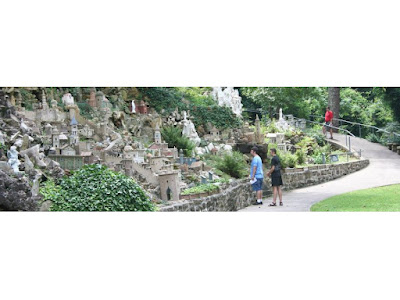
Creator of the Ave Maria Grotto at St. Bernard Abbey Cullman, Alabama Brother Joseph Zoettl, OSB died October 15, 1961
Pictures and Text from the Ave Maria Grotto website http://www.avemariagrotto.com/brother_joseph_zoettl


Brother Joseph Zoettl
"To pass the time, I started hobbies again." Thus the origins of the masterpiece.
Brother Joseph ZoettiBrother Joseph was born on January 24, 1878. In 1891, he almost died of the flu that swept over Europe. In January of 1892, Father Gamelbert Brunner went to Europe looking for candidates for St. Bernard Abbey. Young Michael Zoettl decided to join up, somewhat to the surprise of his parents. In a touching reference, Brother Joseph describes how he and his father, who worked in a brewery, settled for only a glass of cider to mark the occasion. "January 27, 1892 was the date of departure. All night I cried till we entered the railroad car, no homesickness, but what homesickness is I found out many years later in Stonega, Virginia." The comment is a clue to a side of Brother Joseph's life of which few people are aware. As a monk he served as housekeeper for priests in many of our missions. Again a note of interest: one of his priest associates, Brother Joseph was later to write: "he called my cooking poison, he would also examine the coal ashes to see how much coal was in there, then he would call me down." Such menages we can assume took place in Tuscumbia and Decatur, Alabama; Dayton, Tennessee; Pocahontas and Stonega, Virginia.
After his housekeeping career, Br. Joseph was brought to the Abbey and put in charge of the powerhouse built in 1911. Long burdensome workdays of seventeen hours with hardly time to get to Sunday Mass, followed. For thirty years this was his routine. "It became very tedious," he tells later, "for I had to pump from morning to night every day, Sunday included. "To pass the time, I started hobbies again." Thus the origins of the masterpiece. Later in 1918, he tells us, "I began working with cement. The first thing I constructed was a church, that is still in existence, then a year later I began with some small oriental buildings which were later called Little Jerusalem."
Brother Joseph's own words suggest that some of his monastic brethren saw something of the future in his early work. Father Lawrence O'Leary, the guestmaster, took all visitors out to see "it," (and then another presage of the future) "but by and by other people came and it became a real nuisance which could not be stopped anymore." And another early development: "One day Father Dominic (Downs) came to me with some little statues and to see if I could make small grottoes. He had a store in front of the college and sold religious articles to help missions. When I had made two grottoes I thought that would be all but as Father Dominic sold them right away, he always brought more statues and it became a regular business."
By 1932, Br. Joseph's fate was sealed. He was to build a grotto of such size and dimensions as to outdo anything he had ever dreamed of. After making five thousand small grottoes for sale, he commenced work on what is now Ave Maria Grotto. On May 17, 1934 the Ave Maria Grotto was dedicated. Brother Joseph continued his work for over 40 years, using materials sent from all over the world. He built his last model, the Basilica in Lourdes, at the age of 80, in 1958.
Brother Joseph died on October 15, 1961. He was buried in a special bronze coffin. The cost and permanent quality of the coffin had as much to do with the esteem in which his fellow monks held him, as it did with the legacy of fame he had left their home.
Subscribe to:
Posts (Atom)


